Showing posts with label Japan. Show all posts

12 July 2010

Kamakura (June 21-22)

Kamakura is about an hour's train ride south of Tokyo, but the distance doesn't do justice to how different the two places are.  Kamakura's a small beach town with a pretty significant history.  It's often called a former capital of Japan, and historical sources make reference to the Kamakura period in the same way they refer to the Nara, Kyoto, and Edo periods--eras defined by the location of Japan's capital.  According to Wikipedia, however, Kamakura was neither a de jure nor a de facto capital, merely the residence of the Shogun for a time, during which Kyoto was still the capital.  There's no arguing Kamakura's historical or cultural significance, however, and in fact in 1250 CE it was the fourth largest city in the world in terms of population (also according to Wikipedia).  During this time, Buddhist temples in the area developed and thrived, many of which are still in good shape today.

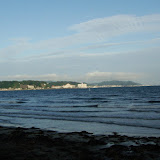
Knowing Kamakura's reputation as a beach town, I was excited to arrive on a bright, sunny afternoon, and after finding and checking into my hostel I asked for the nearest beach and hustled to take advantage of the remaining light.  Walking from the road to the small bay not five minutes from the hostel, I saw surfers galore, validating my beachy ambitions, and I made double-time down the steps of the public access, only to find a rather unappealing beach.  The bay itself was beautiful, but the beach was rocky, and littered with debris, of both the seaweed and trash varieties.  Walking down the beach in hopes of finding a better spot I found two dead and bloody seagulls, effectively killing the remainder of my beach desires.  I contented myself walking up and down the shore, looking for sea glass, on special request from Sarah.  Above: The view from the beach 


As dusk crept on, I ventured back up to the road to read on a bench and watch the sunset--over the land, disappointingly enough--and on my way I passed a 'Beware of Hawks' sign, which explained both the dead seagulls and the paucity of sunbathers.  Looking overhead I did see several hawks hovering effortlessly and looking out to sea, taking advantage of the last of the day's thermals rising from the beach.  Above: The sun sets on a monument near the beach


The next day I toured all of the major temples in the area and was blown away by the architecture and the scenery.  The majority of the temples are located to the north of the actual town, nestled into the mountainside, and can be connected via a hiking course.  It rained throughout the day, and the lush green mountains' peaks were usually obscured by fog, lending an otherworldly feel to the  sacred spaces.  This was negated somewhat by the flocks of tourists.  It's common practice for elementary and junior high students to get steep discounts at religious and historical tourist sites, to promote field trips, and it is an incredibly effective policy.  In the course of the day I saw no less than 30 school groups.  The students look very serious in their uniforms, but this solemnity is quickly corrected by the chorus of enthusiastic 'hellos' I got from a third of the students.  After an acknowledgement, either through a wave, or a greeting, they would inevitably bid me a formulaic--although equally enthusiastic--farewell of 'see you'.  Above: Hard rain falls on the garden at Engakuji temple


One temple I visited had the most beautiful hydrangeas I've ever seen, and had rows upon rows of them in their gardens, but the place was so popular that moving through the gardens was like waiting on line at Disney World, and getting a photo without a tourist's disembodied limb was a challenging task.  Nevertheless, the sights were incredible, particularly the daibutsu, the great Buddha, statue, which at the time I thought was the largest Buddha statue in Japan.  I would discover my mistake a few days later, in Nara, at the actual largest Buddha statue in Japan.  Nevertheless, the daibutsu in Kamakura is no slouch, being in the open air actually makes it feel larger than its counterpart in Nara, and being able to go into the hollow interior of the statue gives it extra points in my book.  Above: Me with the daibutsu.  I'm standing too far forward to get a good sense of scale--plus, I'm pretty tall.  This statue is massive.

Overall, Kamakura was a beautiful town, and a great experience, even if I didn't get my beach time!

More photos:
10 July 2010

Tokyo (June 18-21)

Tokyo is an overwhelming place.  For all of London's quiet splendor, Tokyo has a swaggering extravagance that constantly asserts its modernity.  Districts like Shinjuku and Akihabara in Central Tokyo feel like they were taken straight from a science fiction movie.  Video billboards dominate major streets, and architectural wonders of steel and glass are on every other corner.  Advertisements are bold, colorful, and huge; consumer culture dictates the aesthetics of public space.  In the trendier districts, masses of humanity flock from department store to department store in what Lonely Planet's Japan guidebook calls "contented consumer mode."  Wading down sidewalks every so often one's path leads by a ubiquitous pachinko parlor as someone emerges into the open air, leaving behind the roar of music and the tinkle of hundreds of thousands of yen converted into ball bearings.

And yet outside of the city center it couldn't be more apparent that futuristic Tokyo was built in the increasingly removed past.  The bulk of construction in Tokyo happened in the 1980s, during the country's most successful bubble.  In the 90s the bubble burst, and the rampant and widespread urban expansion slowed.  While the most popular districts in the heart of Tokyo showed no sign of halting construction, the surrounding business districts remain frozen in the speculative future of the '80s.  Science fiction author William Gibson says it best in Wired Magazine:

You can see more chronological strata of futuristic design in a Tokyo streetscape than anywhere else in the world. Like successive layers of Tomorrowlands, older ones showing through when the newer ones start to peel.

In his fantastic article Gibson captures teriffically the spirit of Tokyo's trendy center.  He draws a comparison to Blade Runner, and the analogy is an inevitable one.  Minus the the whole dystopian aspect, Tokyo really feels like a distant future dreamed up in the not-so-distant past.

One of the things I most enjoyed in Tokyo was going to the top of the the Mori Tower in Roppongi, Tokyo's hip and international-friendly cosmopolitan district.  On the 52nd floor of the tower is an  observation deck, from which one may look over Tokyo in 360 degrees.  I went at night, and it was incredible to see the lights of skyscrapers as far as the eye could see in every direction.  I was completely unable to see the end of Tokyo's urban sprawl.  It was an experience which really made me appreciate mankind's ability to change and dominate its environment, and in an incredibly short period of time.  Two centuries prior, Tokyo was a fishing village, and now as far as the eye can see its rooftops mingle with the clouds.  Of course, I forgot my camera, so its an image that will have to live in my memory, unless I manage to go back on my return to Tokyo.

The tower's top floor houses Mori Art Museum, a museum which focuses primarily on multimedia installations, and which was interesting to say the least.  My favorite installation was one in which a Japanese artist, Aikawa Masaru had intricately recreated the cover and packaging of 50 or so of his favorite British and American rock albums, and then recorded his own versions of each of the albums, singing unaccompanied and making up the lyrics where he didn't know them.  A poignant example:  "I once had a girl, / or should I say / shi sha la la."  I liked that the piece spoke about how manufacturing and distribution processes fundamentally alter how we view and consume art, but also that the artist didn't take himself too seriously.  Check out his website for artwork.


Despite all of the fantastic metropolitan scenery, another favorite experience of mine was dedicating a bright, warm Sunday to wandering through Yoyogi park, and seeing Tokyoites take advantage of such wonderful weather.  The park was packed, with musicians, dancers, revelers, and even jugglers, and it was refreshing to see people out enjoying nature and one another's company, especially coming from the expensive and at times seemingly shallow urban center.  In the park's sports facility I got to watch some street and pickup basketball--in my hiking boots, watch was all I did--and tried double dutch jump rope for the first time, thanks to the urgent insistence of some friendly kids. (Above:  Yoyogi park.  Below left: Street ballers showing off.  Below right: My new friends, for whose jump rope I was much too tall.)

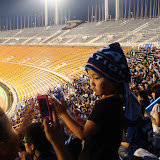
Right next to Yoyogi Park is the Olympic stadium built when Tokyo hosted the 1964 Olympics.  I was lucky enough to get to watch Japan's World Cup match against the Netherlands there, and I was one of very few foreigners to do so, a slightly vain point of pride.  Unlike the performance at Trafalgar, this one went off without a hitch, and my buddy Yuma and I had a great time, despite Japan's unfortunate loss.  I learned some of Japan's fight songs, and was excited to get to experience some sports-induced nationalistic fervor.  I didn't realize how popular soccer is in Japan (the Japanese call it sakka, not football!), but kids everywhere seem to play it, and the country followed Japan's unfortunately shortlived run into the tournament with great excitement. (Below: Shinjuku skyline and a rapidly filling stadium)


When it came time to leave Tokyo I was a little disappointed.  I realize now that I could have easily spent seven weeks in Tokyo and never run out of things to see.  I've got a lot of stuff on my to-do list for when I return for a week in August.

Thanks for reading!  Follow my Twitter for more, ah, current updates.

Mitchell

More photos:
Tokyo

08 July 2010

Religion

Japanese religion is an interesting, syncretic blend of two different traditions: Shinto and Buddhism.  Shinto is the ancient, animistic religion that has existed on the islands in its current form since around the 7th century, but which existed long before that in various forms and traditions.  Shinto recognizes spiritual forces (particularly in nature), and deifies those forces as kami, spiritual forces at work in the universe.  It is important to note that kami are not gods, per se, although some manifestations take the form of figural deities.  Rather, kami are spirits that can take an active or passive role in the goings-on of every day life.  The Wikipedia article compares them to the ancient Roman numina, referring to a sort of spiritual potential in everyday objects, and this comparison feels apt, although kami is a much more encompassing concept, one that I am still trying to come to grips with.

Worship, through prayer, offerings, and ritual, happens at shrines.  Shrines are typically fairly simple structures built on a raised platform.  In visiting a shrine, one stands at the base of the steps of a square building with vaulted roof and looks up into the inner sanctum wherein there is usually some sort of ornate design or pattern.  Shrines themselves rarely contain any sort of figural representation, with the exception of guardian statuary near the entrance, usually in the form of ferocious lions.

Torii gateways (lit. bird perches) are emblematic of Shinto shrines and embody the idea of thresholds as they represent doorways through which both humans and spirits must pass in transitioning between the sacrosanct area of the shrine and the secular area beyond.  Shrines and torii litter the Japanese countryside and from what I've been told most Japanese today still participate in some Shinto traditions, even if only culturally.  Left: Many torii line the path to a high mountain shrine just outside the entrance to Koyasan.

The prevalence of Shinto is not unintentional; Japan's creation story is an important element of Shinto mythology, and its intrinsically tied up with the Imperial line.  To create Japan, greater Kami dipped a spear into the sea and droplets falling from the spear created the archipelago today known as Japan.  Further, the imperial line began as a direct descent from the first founder of Japan, given authority by these divinities.  Today's emperor comes from a direct lineal descent.  As such, the emperor is known as a 'son of heaven,' and throughout history the Shinto beliefs have been used to maintain the authority of the imperial regime.  

Buddhism was imported to Japan from China not long after the codification of Shinto, and the two religions have been in constant dialog since.  Depending on the tendencies of those in power, Buddhism has alternately thrived and suffered in its 1200-year development in Japan.  At times Buddhism was persecuted by the emperor, who saw it as a threat to the divine mandate that Shinto provided the imperial throne.  As late as the mid-19th century Buddhist temples throughout the country were razed to the ground, and many historical sites were destroyed.  Eventually, however, a balance was struck, and now Buddhism and Shinto coexist peacefully.  Most Buddhist temples even contain Shinto shrines, and many of the deities within Japanese Mahayana Buddhism are treated as kami--a prime example of how fluid the concept can be.

Buddhist temples are much more complex and elaborate structures than the typically simple Shinto shrines.  Complexes can span acres and include grand, elaborate buildings with specific, compartmental purposes like worship, ritual, or even religious debate.  Temples usually include a great deal of artwork: statuary, paintings, mandalas; that feature prominent bodhisattvas, (Japanese: bosatsu) who are worshiped like deities within Mahayana Buddhism.  Right: Jizo bosatsu statues in a Buddhist graveyard at Koyasan.  Jizo bosatsu is the guardian of children; a child stands at the foot of each statue, and each Jizo holds a golden, unborn embryo.


There's a short introduction to the two main religions of Japan.  Religious sites are some of my top priorities in my travels, so I'll be writing about specific locations.


07 July 2010

Japan

Updating at last: I'm posting now from an all-night internet cafe in Hiroshima, where I've spent the night in a comfortable, pillowed booth available for hourly renting.  I7m getting a bit ahead of myself, though.  Tomorrow will mark the end of my third week in Japan, and I've got quite a bit of catching up to do.

Rather than make this a marathon post, I'm going to write a shorter post for each of the cities I've been to so far, and I'll have them update automatically over the next week or so.  First, though, I'd like to introduce some information about Japan to help place my future posts into contexts.

I may intersperse later posts with these kinds of informational posts

Culture

I've certainly neither done enough research nor had enough experience with Japanese culture in three weeks to claim anything definitively about Japanese culture, but suffice it to say it differs from American culture in significant ways.  Where America is an individualistic society, emphasizing the success of the individual--and ideally all individuals.  Japan, on the other hand, is a more collectivist society, now organizing around the family unit--and interestingly, around corporations--despite previously focusing primarily on feudal ties.  Japanese collectivism is aimed at producing wa or harmony, in which dispute doesn't arise.  This very fundamental distinction extends beyond nominal organization and influences conceptualization, with Japanese identifying foremost with roles within groups: mother, son, employee; rather than as individuals in the western sense.  These ideas seem to rise from Confucianism, which values order in society through well-defined roles, particularly based on age and family structure.  As a result, Japanese society is one in which men with seniority have traditionally dominated both public and private spheres.

The emphasis on maintaining harmony creates a very polite and efficient, if slightly stiff society.  Kata, which are defined customs for handling different, pre-defined situations, provide the oil to keep Japanese social interactions running smoothly, and therefore society as a whole.  Here's an interesting looking book that explains kata better than I could.  The somewhat mechanized approach to interface kills some of the potential of meaningful human connection, or certainly seems to from a western perspective.  Japanese meaningfully differentiate between the inward self and the interactional self.  While the fundamental inability to truly communicate ideas is one that has plagued philosophers of every culture, the Japanese system of acknowledging that inability seems to give power to it in a way that ensures distance between any two people, regardless of relationship.  Again, I feel that I should offer a disclaimer, because much of the analysis is speculation.  A seemingly well-researched and fascinating book on the subject of Japanese self can be found here.

On the bookshelf of the guesthouse at which I stayed in Kyoto, was this book, from the wonderful bilingual publishing house Kodansha.  Called The Inscrutable Japanese  , its table of contents included subjects like "Why won't Japanese make eye contact with me?" and "Why does everyone respond with yes all of the time?"  I didn't have time to read very much, but I drew some comfort from the fact that these are prominent questions.

All of this being said, I've had the good fortune of spending time with some of the nicest, friendliest, most generous people I've ever met here in Japan.  I don't intend to exoticize Japanese culture or its constituents, but merely to highlight some of the more striking and initially disorienting aspects.

That's it for my brief introduction post about culture.  Look for more posts within the week.  Tomorrow I'll post a very short introduction to religion in Japan, and after that I'll get to the travel stuff.

I'm also going to experiment with Twitter to see if I can't use it for shorter, more regular updates.  You can find my latest tweets on the right-hand side of this page, along with a link to follow me if you're on Twitter.

Sayonara for now!

Mitchell